Drawing a new character is like encountering somebody for the first time. You come to know them as you draw them: you arrive at the edge of their story. Quentin Blake
Several years ago, on a bone-cold winter day, I went on a tour of the site that would become the Quentin Blake Centre for Illustration. It is very close to Sadler’s Wells in Clerkenwell. A friend, who is an illustrator with ‘links’ to the enterprise, had invited me.
The site had originally been part of an industrial site of waterworks. It looked so barren on the day, neglected and forsaken, that I felt as if I was exploring a post apocalypse world. Indeed, the buildings have not been used since the 1950s. It was a challenge to imagine how the concrete ground and bare brick walls of a coal store (see picture), engine house and a pumping station, wherein there was once a “horse gin” whereby a poor beast of burden would go round in circles winding the gears to operate the pump, could be the Centre. Before the birth of this Centre, there was a temporary museum of illustration set up by Blake at King’s Cross. It was the embryo, metaphorically speaking, for the creation we see today.
The 12.5 million transformation is quite remarkable, making the most of historic industry, such that the rebirth of parts is quite light and airy. It is the only permanent establishment, I feel safe pronouncing, in the world for illustration, an unsung artistic phenomenon. The public open spaces have biodiverse planting and cobbles; there is a shop and a café (see picture), a library (see below) and three galleries for changing exhibitions.
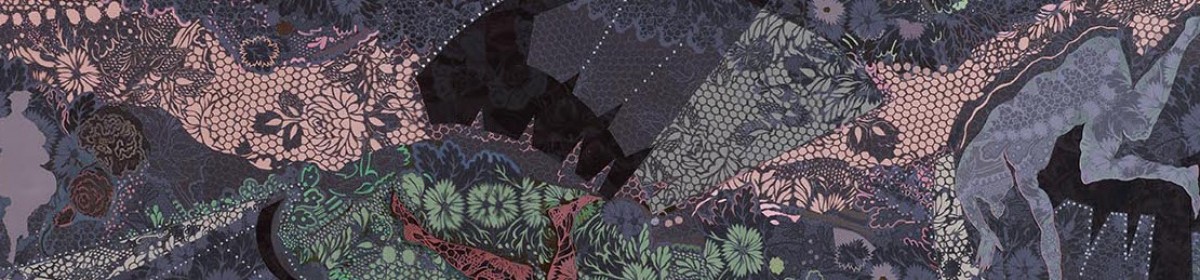
This autumn (2026) you will see an exhibition on the second floor spanning Quentin Blakes’ early theatrical work, his depictions for theatre reviews. The exhibition includes Blake’s illustration of the actor Laurence Olivier in 1957 in The Entertainer at the Royal Court Theatre, London, together with illustrations of works by ancient Greek, Elizabethan and modern playwrights. On the floor below you will see the work of Sri Lankan Murugiah, which is striking for its colourful, kaleidoscopic creations. Murugiah has produced artwork for Apple, Facebook, Penguin and Disney. There is an exhibition on the ground floor focusing on queer comics, strip cartoons, graphic novels and zines during and post the 1940s.
One must only pay an admission charge to view the galleries. The library will be a joy for all, given its content. There you will find contemporary illustration displayed, plus a large collection of books. You can relax with a graphic novel or illustrated magazine. There is a children’s section with many favourite picture books. There are also games, toys, art materials and activities so one can try illustrating.
I would have welcomed better lighting in the gallery devoted to Blake’s theatrical review work. Environmental constraints are limiting, understandably. Could the Centre consider curating a permanent display of panels at the entrance about Quentin Blake spanning his career? Will there ever be another person of such genius and vision in the universe of illustration? The space would be well deserved.
The Centre is very much community focused, rather than an establishment devoted to grand art, worthy of acclaim for its state of the art architectural glamour with chic facilities, such as a panoramic restaurant. Not only does its content seek to communicate and engage, but given its outreach programmes (talks, courses, curator led tours), it is enlightening and educative for people of all ages, shapes, persuasions, creeds, religions, and sexual orientations. It would broaden the horizons of many.
***
What is illustration?
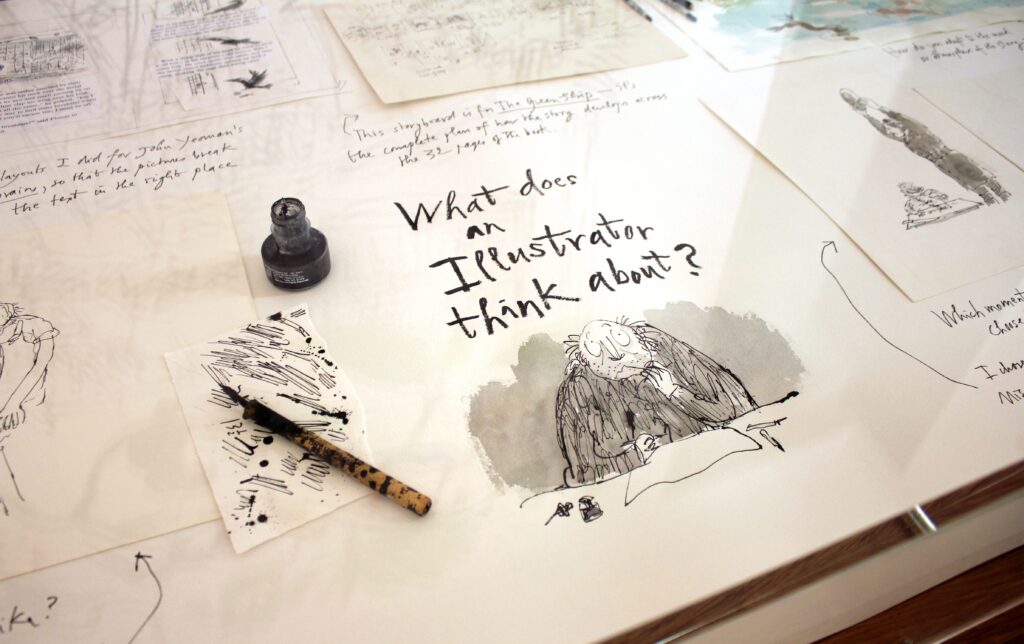
Why do we think of Quentin Blake as an illustrator rather than a painter? For an answer, I first turned to Chris Beetles, the owner of The Chris Beetles Gallery (https://www.chrisbeetles.com) in Ryder Street, St James’s. The Gallery focuses on watercolours, oils, illustrations, cartoon and figurative sculptures. Every November it stages an exhibition celebrating British illustrators and cartoonists.
Now Chris is not only a person in the know, but quite a star. He has been a comedy script writer for radio and television including such series as Doctor on the Go and The Pink Medicine Show. Dr Beetles was once a GP with an inner London practice from 1970 until 1984 when he retired to open the Gallery.
Chris replied
Let us start with a pedantic definition first written by Edmund Sullivan (who was an early inspiration to Arthur Rackham).
“Any art that contains or suggests a reference to something outside itself to the extent that it depends for its interest upon that reference may be said to be an illustration whenever the reference is to a fact or an idea expressible in other terms.”
So, think of a poster trailing a film, a book jacket enticing you into the narrative, a political cartoon by Peter Brookes, a Matt cartoon referencing the idiocy of Net Zero, a comic strip, a Banksy stencil design, a neighbourhood mural, an advertising hoarding, and of course Christmas and birthday cards.
Edmund Sullivan (1869 – 1933), by the way, was a renowned illustrator in his day for books, magazines, newspapers and an influential teacher. He produced a manual The Art of Illustration and lectured on book illustration at Goldsmith’s College.
In case you are feeling overwhelmed by the most erudite reply, one could say that an illustration is a visual representation that explains, conveys information, interprets. It could be made with pencils, pens, paint, clay or digital tools. You may find illustration in textbooks, books, in fashion, advertising and digital culture, on road signs, as comics. Illustration is an essential part of our visual culture. It may accompany text or not. Illustration has a sense of purpose. It justifies itself. It is all over our earthly realm and has been for thousands of years. Think of cave paintings. Illustrations speak to us. They are not simply remote forms of art.
***
Quentin Blake’s illustrations are best known for their pictorial representations of characters in a story. (Of course, there is his early work for theatre reviews.) He has illustrated over 300 children’s books, including some written by Roald Dahl, Dr Seuss, Michael Rosen and Joan Aitken. He has created work for hospitals, such a maternity hospital in Angers, and healthcare centres so that his work may be seen in public spaces, too. He is also a supporter of Survival International, an indigenous rights charity, and Farms for City Children. In 1999, Quentin Blake was made the UK’s first Children’s Laureate, which gave him the unique opportunity to champion illustration. At 93, he is still creating.
***
For further information, please see https://qbcentre.org.uk
Image: Designhistory2