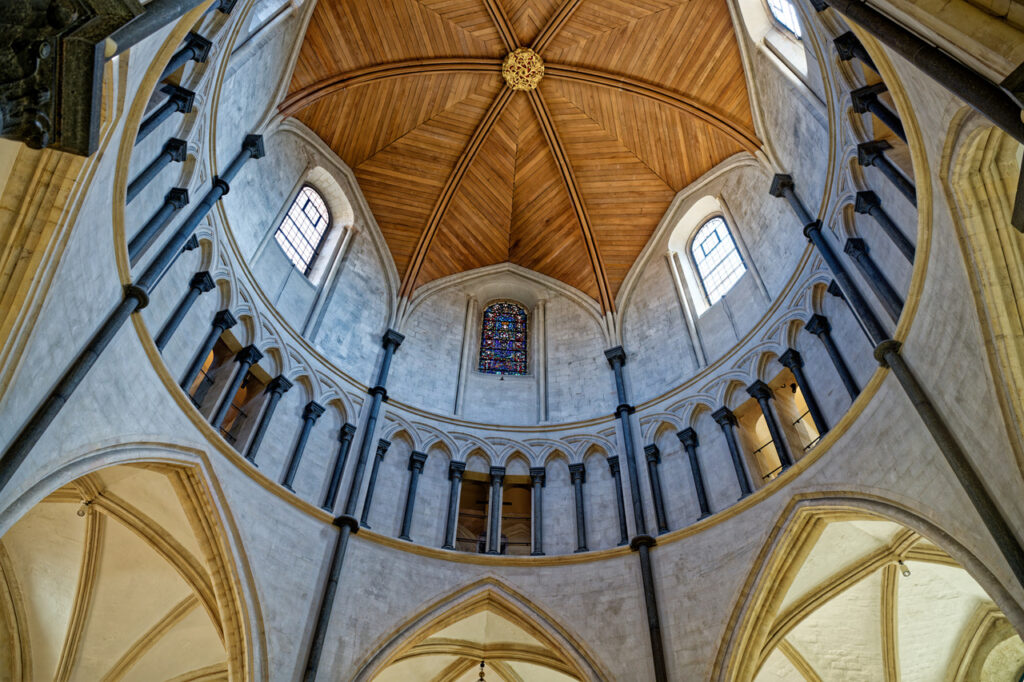
On the day I went for a tour of the Temple Church, we gathered outside the Church in a courtyard bordered by the buildings of the Inner Temple. The afternoon sun shone, and the air was still. Yet we were metres away from the bustle of cars, taxis and buses driving along Fleet Street. Once one enters this elysian world through a wooden door reminiscent of centuries past and strolls down Inner Temple Lane to the church, peace reigns.The Reverend and Valiant Master of the Temple, Dr Robin Griffith-Jones, gave the tour and talk about the history of the church and its acclaimed musical tradition. He has quite a magnetic personality. One would not be surprised if he had been a Shakespearian actor in another realm. The Master started the tour at the western entrance, dating from the 12th century to the Church, which is not the entrance used for people attending services these days, though it will be once the restoration works finishes.
The Knights Templar, an order of knights who took monastic vows, built the church. Also on the Temple site, there were also two halls, cloisters and domestic buildings leading to the Thames. The Templars were founded in 1118 to protect pilgrims to the Holy Land. They were an extremely powerful order in Christendom. The Templars were suppressed in 1314, and the Church passed to the Crown. In 1608 King James I gave the Temple to the two Inns on condition that they use it for the education and accommodation of lawyers and maintain the Church.
After passing through the Great Norman Doorway, to the Round Church and the Chancel, we see various points of interest, some of which the Master elaborated upon. The most notable, one could suggest, is that of William Marshal, First Earl of Pembroke (1142 – 1219). He was an exemplary diplomat given what he achieved. He helped to negotiate the Magna Carta, the first great Bill of Rights, in 1215. King John had alienated many barons who might have supported him such that civil war was brewing, and the King did try to renege on the Magna Carta. Fortunately, William managed to reissue it, once in 2016, and then in 2017. The King needed the loyalty of the barons in order save England from falling under France.
Two other effigies are of protagonists of the Magna Carta, and two of the statues depict barons who wished to ensure that the King conformed to the Magna Carta. They are on loan from the House of Lords. Indeed, there are 18 other such statues in the Lords chamber. Maybe they are reminding the Sovereign to honour the Charter? The crossed leg pose of some of the effigies is meant to represent movement or physical dynamism.
The East Window was designed by Carl Edwards. It was a gift to the Inns from the Worshipful Company of Glaziers as part of the Church’s restoration after the Blitz when it was gutted on the 10 May 1941 by an incendiary bomb. One subject in the window is St Paul’s burning in the Blitz. Another subject is Christ driving the money lenders from the Temple. The South Window was designed by Caroline Benyon, the daughter of Carl Edwards. In the centre one sees the scales of justice suspended from a sword. The altar was designed by Sir Christopher Wren when he helped to refurbish the Church after the Great Fire.
The organ was given to the Church by Lord Glentanar after the Second World War. It had been commissioned for the ballroom of Glen Tanar House in Scotland. When the late Queen came to a service for the organ’s rededication after a programme of repair in 2013, she remarked how pleased she was to hear the organ again. Balmoral is only 15 miles from Glen Tanar.
The Temple Church, The Master tells us, was referenced in the convoluted and controversial (my words) book, The Da Vinci Code, by Dan Brown. Two of the characters venture there looking for clues to the Holy Grail. The Church features briefly in the film adaptation, too. Tourist footfall increased markedly for a time thereafter.
The choir, 16 boy and girl choristers and 12 professional choirmen, is one of the most highly acclaimed in London. It sings in the Church’s services and gives regular concerts in the church. The Church s associated with the Temple Music Foundation, which presents a splendid repertoire of concerts, many of which I have attended.
In 1927, the Temple chorister, Ernest Lough, recorded Mendelssohn’s “O for the Wings of a Dove” in the Church. Over six million copies have been sold. In 2014, part of the soundtrack composed by Hans Zimmer for Interstellar was recorded at the church. This was played on the 1926 four manual Harrison and Harrison organ by the then Church’s music director, Roger Sayer. The score was nominated for an Academy Award.
There is so much more to share. I have given you snippets. Please book a place for a tour, but do remember that a new Master has just arrived.
For more information about tours, services and The Temple Music Foundation, please see https://www.templechurch.com, and https://www.templemusic.org
**